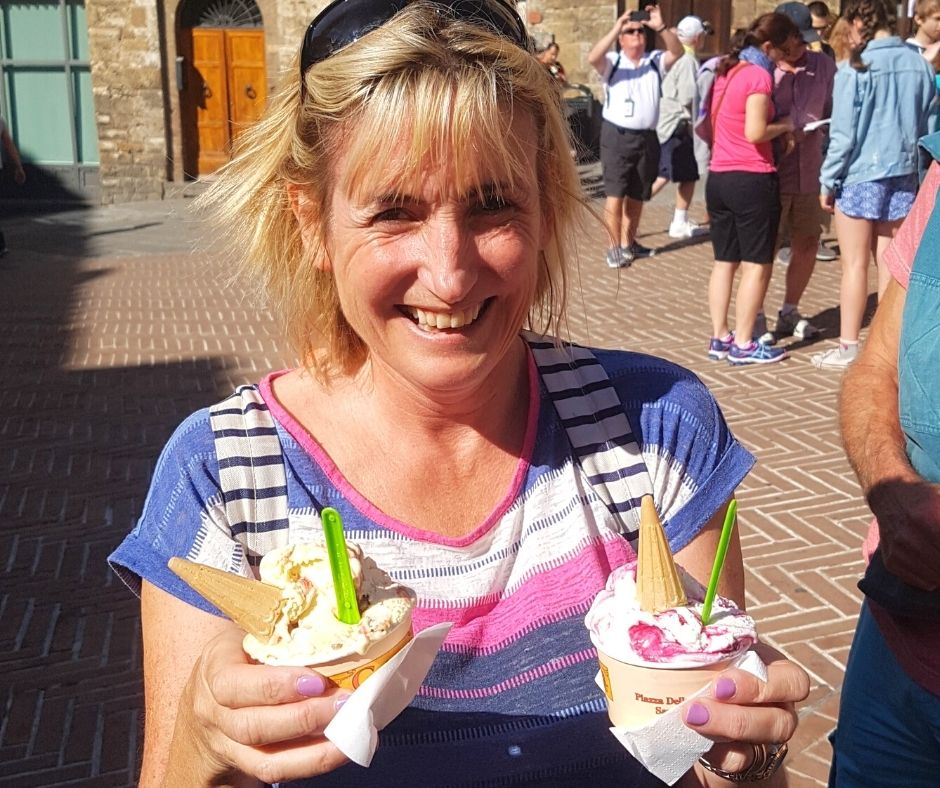

To tell the truth, in Italy we eat gelato all year round (too good!), but it is certainly in the summer that we enjoy this pleasure the most. After lunch (or as lunch), in the afternoon, late at night… any time is good to enjoy a gelato!
It is nice to eat it in company. Imagine a summer evening, the appointment with friends is in the town square: a greeting, laughter and a walk eating an ice cream to cool off and tell each other about the holidays. It is also nice to eat it alone, perhaps on the sofa, in front of a good movie, after a long day of work … because, let’s face it, ice cream definitely cheers you up!
Do you know that the greedy Romans had already invented something very similar to ice cream? At their banquets it was possible to find nivatae potions (frozen drinks), snow mixed with honey and fruit. But they weren’t the only ones: even the Greeks loved preparing drinks based on honey, lemon, pomegranate juice and snow (or ice). Indeed, in China a mixture of milk, rice and spices was prepared and then placed in the snow to solidify. Thus, it seems that there are several ancestors of our beloved gelato!
In Italy, an important turning point took place in our Sicily at the time of Arab domination, in the ninth century. The Arabs imported the cultivation of sugar cane to the island, the main ingredient for their cold drinks with distilled fruit juices called “sherbet” … hence the Italian word sorbetto (sorbet)! During the winter they began to collect the snow that had fallen on the mountains (including that of the Etna volcano) and to store it in special cavities: the snow was solidified by transforming it into ice, then covered with hay and fern leaves to ensure thermal insulation. With this technique they managed to have ice in the summer! Don’t you also think it’s really ingenious?
Instead, it seems that milk and egg-based ice cream was born in Florence in the sixteenth century, thanks to the idea of the architect Bernardo Buontalenti. Definitely a greedy innovation!
Of course, tracing the exact history of ice cream is not easy … but the important thing is that it was invented! Gelato is a moment of lightness, it is treating yourself to a moment of joy. When we are inside the ice cream parlor it seems to me that we are a bit like children again: with our mouth watering, we first choose with care whether we want the cone or the cup and, after a careful study, whether to take our favorite classic flavor again this time or try a new one! It is also true that Italians have their convictions about ice cream: for some the cone always wins against the cup, for others the cream or chocolate flavors are always tastier than those based on fruit! And you, what do you prefer?
Now excuse me… it’s time for a gelato! 😊
Irene T.